Recreating Cybercloud Safeguarding Today

Cyber Security Blog
Blog with us, and Navigate the Cyber Secrets with Confidence!

We are here for you, let us know what you think

Jan 3, 2026

Demystifying AI & Quantum Risks

AI Risks Re-Exposed 馃洝️ Why They’re Special and What to Watch Out For 馃毃

In the future, autonomous AI could run critical systems like government services, public transport, & healthcare. That's the biggest risk—unpredictable failures could cascade massively.


AI isn't like traditional software. It learns & evolves on its own, making issues hard to predict/prevent. Key unique risks:


- Adversarial Attacks: Hackers tweak data to fool AI into disastrous errors.

- Data Dependency & Privacy: Massive datasets invite breaches, misuse, & violations.

- Bias Amplification: AI absorbs & spreads training data biases, causing discrimination.

- Black Box Problem: We often can't explain AI decisions, killing trust & accountability.


馃毃 Implications 

- Individual: Biased algos deny jobs/loans unfairly.

- Organizational: Security gaps lead to breaches & reputational damage.

- Ecosystem: Algo trading crashes markets; automated logistics grinds supply chains to a halt.


Unlike IT bugs (fixable with patches), AI risks hit the "brain" of the system—need specialized defenses.


Quantum Risks

Future wise, the Quantum Ripple Effect amplifies AI threats when quantum computing intersects with autonomous systems: Quantum processors could shatter current encryption, exposing vast AI training datasets to breaches and enabling adversaries to manipulate models at scale. 


A slippery slope ⚠️ or a snowball effect that has increased the risks: increasing bias becomes discrimination, hostile attacks become catastrophic, and black box failures in critical sectors like healthcare or the Internet cause ecological-wide failures.


As AI evolves toward quantum integration, unprepared systems face exponential vulnerabilities, demanding urgent quantum-resistant protocols to prevent ripple-like global disruptions.


Therefore, Let's try to build safely AI - according to regulations like

- NIST AI RMF, - OECD or - EU AI act.

Let's prepare to mitigate risks in AI while strengthening the protections and encryptions threatened by quantum computing, to strengthen against these future risks! ☠️


Would you like to share a thoughts 馃挱 ? 


https://youtu.be/OufwfdcxrNk?si=k-gEjE-4JGtAoN-Q


#AIRisks #xAI #QuantumRisks #Quantum


Dec 27, 2025

You find it's a tight regulation for a new artificial intelligence (AI) - No problem

 Building a new AI system? Don't wait for regulation to surprise you 馃殌

The world is moving towards tight regulation of artificial intelligence, but the average entrepreneur or product manager finds himself facing a maze: the European EU AI Act, the US NIST standards and the OECD principles.


What's the difference and how do you stay relevant?

Basically, everyone agrees on the "what": human rights, fairness, transparency and safety. But the "how" is completely different: 馃敼 OECD: Voluntary value framework ("Soft Law"). The moral compass that everyone started with. 馃敼 EU: Mandatory regulation ("Hard Law") with teeth, risk classification and heavy fines. 馃敼 US: A combination of voluntary guidelines and sectoral regulation (health, finance).

馃棷️ My tip: Start with the OECD, but aim for UFA 馃幆 If you align yourself with the OECD principles, you are already on the right track. But to be truly market-ready Globally, it is worth adopting the Unified Framework Approach (UFA): adopting the most stringent standard (usually the European one) as the house standard. This saves expensive "corrections" afterwards.


Quick checklist for alignment (OECD Alignment):

✅ Defining uses and risks: Who are the users? What are the prohibited/sensitive uses? ✅ Data and model: Documenting the sources of information, legal basis (Consent) and separation between training and testing sets. ✅ Pre-launch testing: Accuracy metrics, fairness tests (Bias testing) and robustness. ✅ Transparency and accountability: Clearly wording for the user when he is facing AI, how to challenge a result and who is responsible in the organization. ✅ Continuous monitoring: A channel for reporting failures and setting time points for re-testing (quarterly/semi-annually).

Bottom line: Regulatory compliance is not just a legal "headache" - it is a tool for building trust with your customers. Company A company that documents and manages risks in advance is an easier company to sell and invest in.


Dec 11, 2025

AI Cybersecurity Foundations

 The document 馃搶 "AI Cyber ​​​​Security Lays the Foundation"


is a concise, focused and practical guide that aims to lay the foundation for understanding cybersecurity in artificial intelligence (AI) systems. It is aimed at a professional audience – such as security officers (CISOs), developers, organizations and research – and provides a practical descriptive framework to address the unique security challenges of AI, such as generative models (LLM) and autonomous agents (Agentic AI).


To read or watch 馃憗️ click on the link 馃憟馃徎 https://lnkd.in/dUf6-eek ✋馃徎


#AI_Security_Security #AI_Security_Foundation

Oct 13, 2025

Prompt Injection: a simple explanation for busy people

Prompt Injection: Plain-English guide 馃憞

A prompt injection is when someone sneaks instructions into text that an AI model reads - causing the model to ignore its original rules and do something it shouldn’t. Think of it like a cleverly worded detour sign that makes the AI takes a wrong turn.
 (NJP 2025)

What exactly is “prompt injection”?

Prompt injection is a tactic where attackers craft input (a message, a web page, a PDF or other documents, even hidden text) that overrides the AI’s intended behavior. The model then leaks data, executes unintended actions, or produces misleading output because it treats the injected text as higher-priority instructions. This can happen with direct prompts the user types or indirect prompts buried in external content the AI ingests.

Why should an organization care?

  • Data exposure: AI may reveal confidential info (PII, system prompts, credentials, source content). 

  • Unauthorized actions: If the AI can call tools/APIs, injected prompts may trigger emails, file operations, or risky workflow steps. 

  • Brand & compliance risk: Hallucinated or manipulated outputs can misinform customers, violate policies, or create audit findings. 

  • Supply-chain knock-on effects: Compromised plugins, connectors, or data sources can propagate malicious instructions into multiple apps.

What’s the risk to an individual user?

  • Privacy loss: Attackers can trick the model into recalling prior chat content or personal details the user provided. 

  • Fraud & social engineering: Poisoned outputs can steer users to phishing links or bad decisions that appear “AI-approved.” 

  • Reputation & errors: A junior analyst copying AI output into email or code can spread falsehoods or vulnerable snippets. 


What typically causes prompt injections?

  1. Trusting user text as instructions (no separation between “data” and “directives”).

  2. Indirect prompt sources like websites, PDFs, knowledge bases, and tickets that the AI reads automatically.

  3. Insufficient output handling (treating model text as safe to render, click, or execute). 

  4. Over-privileged tool access (the AI can perform powerful actions with little control). 

Fastest ways to reduce the risk (do these first)

For product owners / platform teams

  • Partition “instructions” from “data.” Use strict system prompts and message roles; never let external content change the AI’s core rules. 

  • Guard RAG & browsing.

    • Allow-list trusted domains and repositories.

    • Strip or neutralize markup, hidden text, and “system-like” phrases before retrieval.

    • Summarize sources rather than pasting raw content into the prompt. 

  • Validate model output before acting. Treat AI text as untrusted: sanitize, escape, and require human or policy checks before any action (click, execute, send, write to DB). 

  • Least privilege for tools/APIs. Scope tokens, rate-limit, add transaction guards (“are you sure?”), and require approvals for sensitive actions. 

  • Detection & monitoring. Log prompts/outputs, flag patterns (e.g., “ignore previous instructions”), and red-team with known injection strings during CI/CD. 

For security & governance

  • Adopt OWASP LLM Top 10 controls. Map your AI apps to LLM01 (Prompt Injection) and related risks (e.g., Sensitive Information Disclosure), then document mitigations. 

  • Policy & training. Publish short usage rules: do not paste secrets, verify links, and never execute code solely because the AI suggested it. 

For end users (fast hygiene wins)

  • Don’t paste sensitive data unless it’s explicitly approved.

  • Be skeptical of outputs that urge urgency, secrecy, or “ignore previous instructions.”

  • Confirm critical steps (money, credentials, production changes) with a second channel or a human. 


A simple mental model for juniors

  • Data is not instructions. Anything the AI reads might try to boss it around.

  • AI output is not truth. Treat it like a smart intern’s draft review before you act.

  • Power needs brakes. The more tools the AI can use, the more guardrails you must add. 


The Bottom line

Prompt injection is LLM risk No. 1 because it exploits the very thing that makes AI useful its responsiveness to natural language. Start by separating instructions from data, treating AI output as untrusted, locking down tool access, and adopting OWASP LLM Top 10 controls. These steps deliver the fastest, most meaningful drop in risk for both organizations and individual users. 


 - - - - - - - - - - - 

FAQ

  • Is this the same as “jailbreaking”?
    Related but different: jailbreaking tries to bypass safety rules via user prompts; prompt injection also includes hidden or indirect instructions from external content. 

  • Can prompt injections be invisible?
    Yes. They can be embedded in code comments, HTML, PDFs, or metadata that humans might not notice - but the model parses. 


Sources used:

  1. OWASP GenAI Security Project LLM01: Prompt Injection and LLM Top 10 (2023–2025). 
  2. Palo Alto Networks Cyberpedia: What Is a Prompt Injection Attack? and What Is AI Prompt Security?

Oct 4, 2025

Rise in AI Trends for Cyber Defense Services

The writer is a Cyber risk expert and researcher in Law and technology trends: NJ passi

The Digital Arms Race and the Need for Balance 馃憞

In the current digital era, where information systems are the lifeblood of businesses, governments, and critical infrastructure, cyber attackers (Black Hats) leverage artificial intelligence (AI) to enhance the efficiency of their attacks. AI-based tools enable them to identify code vulnerabilities, generate personalized attacks, and adapt strategies at an astonishing speed. However, the scalable counter-solution is the development of AI systems that empower human capabilities on the defense front: accurate vulnerability detection, high-quality fix suggestions, and acceleration of analysis processes in complex environments like Security Operations Centers (SOCs). This post, based on current trends and up-to-date research, examines how AI systems are becoming an essential tool for organizational cyber defenders. From organizational security teams to security researchers and maintainers of open-source software, as well as risk managers shaping long-term defense strategies, all require these capabilities. I will focus on the rationale visible today, with an emphasis on investments in development and their impact on the field, including changes in workforce structure in the industry, as seen in current trends.


馃憠 Directions of LLM Companies and Security Companies

Large AI companies (LLMs) like Anthropic are leading the shift to AI-based cyber defense, focusing on specific defensive tasks. In their latest article, Anthropic introduced Claude Sonnet 4.5, an AI model specializing in code vulnerability detection, fix creation, and network analysis, while avoiding any enhancements that favor offensive activities like writing malicious software. (https://red.anthropic.com/( The model achieves faster and more comprehensive results than humans; for example, it solved CTF (Capture-the-Flag) challenges in just 38 minutes, compared to an hour or more for human experts. The model detects new vulnerabilities in 33% of open-source code projects.

This is part of a broader trend where LLM companies are investing in defensive research to balance the advantage attackers gain from AI systems, as seen in disruptions created by Anthropic against cyber operations using AI for data fraud or espionage.

This trend is spreading to additional AI companies. For example, Google launched "A Summer of Security" in July 2025, an initiative including the Big Sleep agent for faster code vulnerability detection and the Google Unified Security platform that integrates data checking, threat intelligence, unified SOC, and AI-based automation. OpenAI, for its part, published a report in June 2025 on disruptions it created against malicious uses of its AI model, including collaboration with the U.S. Department of Defense to enhance AI capabilities in cyber defense. This defense emphasizes preventing AI exploitation by authoritarian regimes.

These companies are partners in the trend of focusing on defensive development, while integrating AI into existing tools to empower cyber defenders and information security.

At the same time, traditional security companies are integrating LLMs and AI into SOC management systems to achieve maximum control over incident analysis. For example, Palo Alto Networks completed the acquisition of IBM's QRadar SaaS assets in 2024, strengthening its Cortex XSIAM platform through integration of advanced SIEM capabilities.

This acquisition advanced SOC capabilities to address new issues like advanced AI threats and automation in threat detection, making Palo Alto a key player in the market. Not only due to internal AI development but also seamless integration with existing systems, enabling major wins already in 2025. Splunk, which currently dominates the SOC systems market as a leader in SIEM, emphasized in its State of Security 2025 report the need for a smarter SOC.

59% of organizations report that AI systems improve SOC efficiency. Along with automation of threat detection and reduction of alert fatigue states, while integrating platforms like Cisco Data Fabric. This, through machine learning integration for real-time identification of important security events. This trend is based on a practical need for AI systems that enable faster and more comprehensive analysis than a professional human and reduce incident response time by approximately 44%, in cases as examined in HackerOne cyber incidents.


馃憠 Use Cases - AI as a Human Empower

AI does not replace organizational cyber defenders but empowers them in specific tasks. Here are examples based on current implementations:

  1. Vulnerability Detection and Fixing in Code - In the DARPA AI Cyber Challenge, teams used LLM models like Claude to analyze millions of lines of code, identify new vulnerabilities, and create fixes, including those integrated into open-source software. AI scans code at a high scale, offers precise solutions, and reduces fix time from days to just a few hours.
  2. SOC Automation, Real-Time Threat Detection - CrowdStrike uses the Falcon AI platform to detect anomalous behaviors in endpoints, cloud access, and data, and responds automatically to threats. For example, it analyzes network traffic and dismantles malicious software, with a 76.5% success rate in Cybench challenges, double that of previous models. This allows SOC teams to focus on strategy instead of manual analysis.
  3. Organizational Risk Management, Vulnerability Exploitation Prediction - Microsoft Security Copilot uses AI to predict which vulnerabilities will be exploited based on trends and offers tailored fixes. For open-source maintainers, Darktrace provides behavioral analysis that detects vulnerabilities in WiFi and cloud systems, while providing repair recommendations.
  4. Incident Response - Triage Automation - SentinelOne integrates AI for zero-day detection and automatic response, including endpoint isolation. This reduces damage by 50% on average.

馃憠 Mapping of Leading Global Companies - Impact and Investments

Investments in AI for cyber defense surged in 2025, with a forecast of 5-7 trillion dollars in global economic trends. AI is becoming a leading investment target in security budgets. 74% of organizations report seeing positive impact from AI technologies in their organization (www.pwc.com). This highlights that AI systems are the top investment priority, also to address workforce shortages and increase operational efficiency. Below is a table mapping key global companies:


See table:

Company

AI Focus

Example of Impact

Investments/Trends 2025

Anthropic (Claude)

Vulnerability detection and code fixing

Partnership with CrowdStrike and HackerOne, 44% reduction in response time

Investment in defensive research, AI-based threat disruptions

Palo Alto Networks (Cortex XSIAM)

SOC automation and threat detection

QRadar SaaS acquisition, automatic alert enrichment, AI model protection

Dominance in AI-security market, 30% growth in AI investments, major SIEM wins

CrowdStrike (Falcon)

EDR and behavioral analysis

Cloud threat detection and AI workloads, 76.5% success in CTF

Native AI platform, investments in AI security on AWS

Darktrace

Behavioral analysis and prediction

Azure protection, anomaly detection in data

Leading predictive AI, partnerships with Microsoft

SentinelOne

Endpoint protection and automated response

Zero-day detection, cloud identity management

8 leading AI-security companies, growth in AI EDR

Microsoft (Security Copilot)

Risk prediction and fixing

Integration with Azure, vulnerability trend analysis

Top investment target, 55% IT efficiency improvement

Google (Big Sleep & Unified Security)

Vulnerability detection and unified SOC

"Summer of Security" initiative, AI automation

Investments in defensive AI, Growth Academy for expansion

Splunk

SIEM and smart SOC

State of Security 2025, tier-1 automation

SOC market dominance, 59% AI efficiency improvement

OpenAI

Disruption of malicious uses

June 2025 report, DoD collaboration

Focus on preventing AI threats, built-in security

Investment trends are emphasizing a shift to unified AI platforms, with a focus on SOC automation and protection of AI itself, as seen in organizations investing in customer support and IT efficiency improvements through the use of AI.


馃憠 Change Index - AI Efficiency vs. Humans and Workforce Structure Changes

As investments in AI development for cyber defense grow—with AI as the top budget priority—the change index becomes dramatic: 56% of organizations report improvement in threat prioritization capabilities, and 51% in enhanced SOC efficiency. AI systems are more efficient than humans in several metrics: analyzing massive data volumes in real-time (e.g., Google's Big Sleep detects vulnerabilities several times faster than a human expert), reducing human errors by 30-50%, and automating tier-1 tasks. The system responds to threats on a global scale without signs of fatigue in detection. However, AI requires human oversight for complex strategies. (https://mixmode.ai))

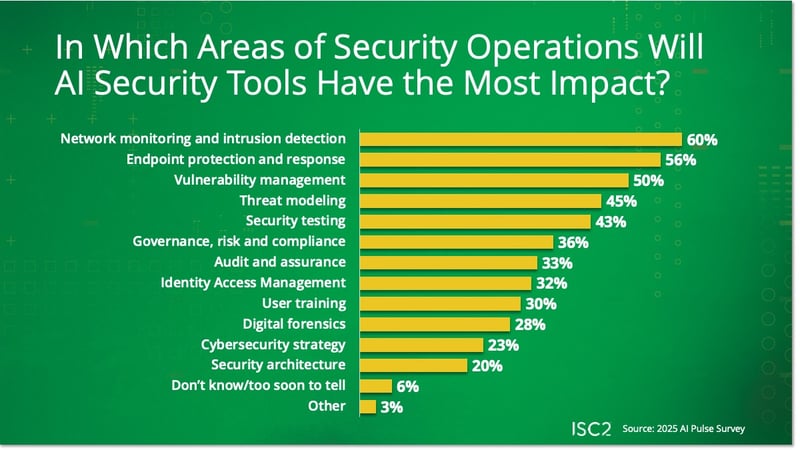
This change will profoundly impact the future workforce structure in cyber defense and information security departments. 52% of experts predict impact on entry-level hiring, with automation of basic tasks freeing analysts to focus on tier-2/3 (deep investigation and strategy) (www.isc2.org). Splunk reports that its SOC automated tier-1 without layoffs, but by reallocating workforce to higher-priority tasks – increasing efficiency by 43%. However, 46% of employees fear job loss, and 50% are concerned about AI accuracy risks. Organizations that invest more will see a shift to an "AI-savvy" workforce – experts combining AI with human judgment – which will reduce talent shortages by 30% and improve threat response by 55%.


馃憠 AI as a Partner in "Scalable Defense"

Building AI for cyber defense is not futurism; it is a current reality that balances the arms race. By empowering defenders through accurate vulnerability detection, SOC automation, and fix suggestions, we enable security teams, researchers, and risk managers to focus on implementing organizational defense strategy. The following investments in the field, around 5 trillion dollars and the expected impact, indicate acceleration in development in the field, but the emphasis must be on data-based implementations, as led by Anthropic, Google, Palo Alto, and Splunk. That is, not investing in unproven futuristic technologies, but focusing on practical applications based on real data: research, experiments, and measurable metrics.


Copyrights: isc2.org

Aug 21, 2025

Cyber ​​Threats to the Israeli Healthcare System - 2025 馃毃: What Every Manager Must Know

 Cyber ​​Threats 

馃毃 Healthcare System - 2025馃毃

What Every Manager Must Know

Are you ready for the critical cyber challenges that await the Israeli healthcare system in 2025?

The Disturbing Reality: 24% Increase in Cyber ​​Incidents 馃搱

Fresh data from the Ministry of Public Security shows a 24% increase in reported cyber incidents in 2024, with the healthcare system at the forefront of the targets. This is not just another statistical report - this is a reality that directly affects the continuity of patient care.


7 Critical Cyber ​​Threats Threatening the Israeli Healthcare System:

馃幆 1. State Cyber ​​War

  • APT Groups Targeting the Israeli Healthcare System Specifically
  • Paralyzing Hospital Networks in Times of Crisis
  • Damaging Emergency Coordination Systems


馃挵 2. Advanced Digital Ransomware

  • Moving from Encryption to Data Theft + Extortion
  • 238 Ransomware Threats in Global Healthcare Systems in 2024
  • Prolonged Disruption to Patient Services


馃敁 3. Data Theft and Access Credentials

  • A Sharp Increase in Password Stealing Software
  • Breach of Health Insurance Systems
  • Damage to Sensitive Patient Information


馃摫 4. Attacks on Medical Devices

  • Exploiting Connected Medical Devices as an Entry Point
  • Vulnerabilities in Israeli PLC Systems (Unitronics)
  • Infiltration Through Devices with Weak Security


☁️ 5. Cloud Threats

Incorrect Configurations in Cloud EHR Systems

Weak Identity Controls

Exploiting Medical Information Sensitive


馃 6. Artificial Intelligence Threats

Using AI for sophisticated phishing attacks

Poisoning medical models

Forgery of doctor and patient identities


馃敆 7. Supply chain threats

Overreliance on external suppliers

One breach = multiple system shutdown

Lack of control over suppliers


 The new obligations: Amendment 13 to the Privacy Protection Law 馃搵

Starting August 14, 2025 - every healthcare organization must appoint a Data Protection Officer (DPO). Are you ready?


馃幆 Why is this report different?

✅ Intelligence-based analysis from relevant public websites

✅ Focus on Israel - specific threats to the geopolitical situation

✅ Practical recommendations for reducing risks

✅ Alignment with Ministry of Health requirements

✅ Lessons from the CrowdStrike incident that disabled dozens of hospitals in Israel


馃挕 What will you find in the full report?

Detailed Threat Map for 2025

  • Defense Strategies Tailored to the Israeli Healthcare System
  • Intelligence Insights from the Field
  • Implementation Guide for Ministry of Health Requirements
  • Documented Source List for More Information

馃摜 Download the Full Risk Report Now

"Healthcare Cyber ​​Threats Matter 2025 - Israel Focus"

By Nir Jonathan Passi - Cyber ​​Due Diligence


馃搳 The full report includes:

  • In-depth analysis of each threat
  • Implementation recommendations specific to Israel
  • Practical tools for risk assessment
  • A guide to meeting regulatory requirements


⚡ In a world where one cyber threat can paralyze an entire hospital - knowledge is your best defense.


Don't wait for the next breach. Prepare now...

Aug 15, 2025

讗讬讜诪讬 住讬讬讘专 注诇 转注砖讬讬转 讛讘专讬讗讜转 讘讬砖专讗诇 - 2025: 诪讛 砖讻诇 诪谞讛诇 讞讬讬讘 诇讚注转

讗讬讜诪讬 讛住讬讬讘专 注诇 诪注专讻转 讛讘专讬讗讜转 讘讬砖专讗诇 - 2025馃毃: 诪讛 砖讻诇 诪谞讛诇 讞讬讬讘 诇讚注转

讛讗诐 讗转诐 诪讜讻谞讬诐 诇讗转讙专讬 讛住讬讬讘专 讛拽专讬讟讬讬诐 砖诪讞讻讬诐 诇诪注专讻转 讛讘专讬讗讜转 讛讬砖专讗诇讬转 讘砖谞转 2025?

讛诪爪讬讗讜转 讛诪讟专讬讚讛: 注诇讬讬讛 砖诇 24% 讘讗讬专讜注讬 住讬讬讘专 馃搱

谞转讜谞讬诐 讟专讬讬诐 诪讛诪砖专讚 诇讘讬讟讞讜谉 讛驻谞讬诐 诪专讗讬诐 注诇讬讬讛 砖诇 24% 讘讗讬专讜注讬 住讬讬讘专 砖讚讜讜讞讜 讘-2024, 讻讗砖专 诪注专讻转 讛讘专讬讗讜转 谞诪爪讗转 讘讞讝讬转 讛诪讟专讜转. 讝讛 诇讗 注讜讚 讚讜讞 住讟讟讬住讟讬 - 讝讜 诪爪讬讗讜转 砖诪砖驻讬注讛 讬砖讬专讜转 注诇 讛诪砖讻讬讜转 讛讟讬驻讜诇 讘讞讜诇讬诐.

7 讗讬讜诪讬 讛住讬讬讘专 讛拽专讬讟讬讬诐 砖诪讗讬讬诪讬诐 注诇 诪注专讻转 讛讘专讬讗讜转 讛讬砖专讗诇讬转:

馃幆 1. 诪诇讞诪转 住讬讬讘专 诪诪诇讻转讬转

  • 拽讘讜爪讜转 APT 诪讻讜讜谞讜转 住驻爪讬驻讬转 诇诪注专讻转 讛讘专讬讗讜转 讛讬砖专讗诇讬转
  • 砖讬转讜拽 专砖转讜转 讘讬转 讞讜诇讬诐 讘讝诪谞讬 诪砖讘专
  • 驻讙讬注讛 讘诪注专讻讜转 转讬讗讜诐 讞讬专讜诐

馃挵 2. 讻讜驻专讜转 讚讬讙讬讟诇讬讜转 诪转拽讚诪讜转

  • 诪注讘专 诪讛爪驻谞讛 诇讙谞讬讘转 诪讬讚注 + 住讞讬讟讛
  • 238 讗讬讜诪讬 讻讜驻专讛 讘诪注专讻讜转 讘专讬讗讜转 讙诇讜讘诇讬讜转 讘-2024
  • 讛驻专注讛 诪诪讜砖讻转 诇砖讬专讜转讬 讞讜诇讬诐

馃敁 3. 讙谞讬讘转 诪讬讚注 讜讗讬砖讜专讬 讙讬砖讛

  • 注诇讬讬讛 讞讚讛 讘转讜讻谞讜转 诇讙谞讬讘转 住讬住诪讗讜转
  • 驻专讬爪讛 诇诪注专讻讜转 讘讬讟讜讞 讘专讬讗讜转
  • 驻讙讬注讛 讘诪讬讚注 专讙讬砖 砖诇 诪讟讜驻诇讬诐

馃摫 4. 讛转拽驻讜转 注诇 诪讻砖讬专讬诐 专驻讜讗讬讬诐

  • 谞讬爪讜诇 诪讻砖讬专讬诐 专驻讜讗讬讬诐 诪讞讜讘专讬诐 讻谞拽讜讚转 讻谞讬住讛
  • 驻讙讬注讜转 讘诪注专讻讜转 PLC 讬砖专讗诇讬讜转 (Unitronics)
  • 讞讚讬专讛 讚专讱 诪讻砖讬专讬诐 注诐 讗讘讟讞讛 讞诇砖讛

☁️ 5. 讗讬讜诪讬 注谞谉

  • 转爪讜专讜转 砖讙讜讬讜转 讘诪注专讻讜转 EHR 注谞谞讬讜转
  • 讘拽专讜转 讝讛讜转 讞诇砖讜转
  • 讞砖讬驻转 诪讬讚注 专驻讜讗讬 专讙讬砖

馃 6. 讗讬讜诪讬 讘讬谞讛 诪诇讗讻讜转讬转

  • 砖讬诪讜砖 讘AI 诇讛转拽驻讜转 驻讬砖讬谞讙 诪转讜讞讻诪讜转
  • 讛专注诇转 诪讜讚诇讬诐 专驻讜讗讬讬诐
  • 讝讬讜祝 讝讛讜转 砖诇 专讜驻讗讬诐 讜诪讟讜驻诇讬诐

馃敆 7. 讗讬讜诪讬 砖专砖专转 讗住驻拽讛

  • 转诇讜转 讬转专 讘住驻拽讬诐 讞讬爪讜谞讬讬诐
  • 驻专讬爪讛 讗讞转 = 砖讬转讜拽 诪注专讻讜转 诪专讜讘讜转
  • 讞讜住专 讘拽专讛 注诇 住驻拽讬诐

馃搵 讛讞讜讘讜转 讛讞讚砖讜转: 转讬拽讜谉 13 诇讞讜拽 讛讙谞转 讛驻专讟讬讜转

讛讞诇 诪-14 讘讗讜讙讜住讟 2025 - 讻诇 讗专讙讜谉 讘专讬讗讜转 讞讬讬讘 诇诪谞讜转 拽爪讬谉 讛讙谞转 诪讬讚注 (DPO). 讛讗诐 讗转诐 诪讜讻谞讬诐?

馃幆 诇诪讛 讛讚讜讞 讛讝讛 砖讜谞讛?

谞讬转讜讞 诪讘讜住住 诪讜讚讬注讬谉 诪讗转专讬诐 爪讬讘讜专讬讬诐 专诇讜讜谞讟讬讬诐
✅ 讛转诪拽讚讜转 讘讬砖专讗诇 - 讗讬讜诪讬诐 住驻爪讬驻讬讬诐 诇诪爪讘 讛讙讬讗讜-驻讜诇讬讟讬
✅ 讛诪诇爪讜转 诪注砖讬讜转 诇讛拽讟谞转 住讬讻讜谞讬诐
✅ 讬讬砖讜专 注诐 讚专讬砖讜转 诪砖专讚 讛讘专讬讗讜转
✅ 诇拽讞讬诐 诪讗讬专讜注 CrowdStrike 砖讛砖讘讬转 注砖专讜转 讘转讬 讞讜诇讬诐 讘讬砖专讗诇

馃挕 诪讛 转诪爪讗讜 讘讚讜讞 讛诪诇讗?

  • 诪驻转 讗讬讜诪讬诐 诪驻讜专讟转 诇砖谞转 2025
  • 讗住讟专讟讙讬讜转 讛讙谞讛 诪讜转讗诪讜转 诇诪注专讻转 讛讘专讬讗讜转 讛讬砖专讗诇讬转
  • 转讜讘谞讜转 诪讜讚讬注讬谞讬讜转 诪讛砖讟讞
  • 诪讚专讬讱 讬讬砖讜诐 诇讚专讬砖讜转 诪砖专讚 讛讘专讬讗讜转
  • 专砖讬诪转 诪拽讜专讜转 诪转讜注讚转 诇诪讬讚注 谞讜住祝

馃摜 讛讜专讬讚讜 讗转 讛讚讜讞 讛诪诇讗 注讻砖讬讜

"Healthcare Cyber Threats Matter 2025 - Israel Focus"
诪讗转 谞讬专 讬讛讜谞转谉 驻住讬 - Cyber Due Diligence

馃搳 讛讚讜讞 讛诪诇讗 讻讜诇诇:

  • 谞讬转讜讞 诪注诪讬拽 砖诇 讻诇 讗讬讜诐
  • 讛诪诇爪讜转 讬讬砖讜诐 住驻爪讬驻讬讜转 诇讬砖专讗诇
  • 讻诇讬诐 诪注砖讬讬诐 诇讛注专讻转 住讬讻讜谞讬诐
  • 诪讚专讬讱 诇注诪讬讚讛 讘讚专讬砖讜转 专讙讜诇讟讜专讬讜转

⚡ 讘注讜诇诐 砖讘讜 讗讬讜诐 住讬讬讘专 讗讞讚 讬讻讜诇 诇砖转拽 讘讬转 讞讜诇讬诐 砖诇诐 - 讛讬讚注 讛讜讗 讛讛讙谞讛 讛讟讜讘讛 讘讬讜转专 砖诇讻诐.

讗诇 转讞讻讜 诇驻专讬爪讛 讛讘讗讛. 讛转讻讜谞谞讜 注讻砖讬讜...


How to build a cyber security controls methodology

 How do you build a 馃搶 security/controls methodology馃攼 that works for any organization?

After years of working with complex cyber risk management methodologies, I decided to think outside the box 馃挕 and build something simpler - but no less effective.


馃搱 When I need to adapt a methodology to an organization, I usually start with a risk management framework (such as CIAAN), and instead of approaching it only through traditional risk management, I create a threat map and build an appropriate control structure. Here I developed a methodology based on the 12 Pillar’s, which I developed for the information protection architects of a large healthcare organization, and as I did, each organization can adapt to its unique needs. 馃憤馃徎


Why 12? 馃帗

The number 12 carries a meaning of completeness and order in many cultures 馃枛馃徎 - 12 tribes, 12 messengers, 12 months 馃搮, 12 hours 馃晸, 12 zodiac signs 馃徆. It represents a foundation for stability and integrity, exactly what we are looking for in information security. 馃摀


The 12 key pillars for reducing cyber risks:


馃搷 Authentication - Identifying and validating user identities

馃搷 Authorization - Defining permissions and approaches

馃搷 Encryption - Protecting information at rest and in motion

馃搷 Network Security - Protecting the communication infrastructure

馃搷 Endpoint Security - Secure devices and connections

馃搷 API Security - Protecting software interfaces

馃搷 SSDLC and container security - Security at the development level

馃搷 Vulnerability Management - Identifying and addressing weaknesses

馃搷 Supply Chain and Third-Party Controls - Protecting against suppliers

馃搷 Auditing and Compliance - Compliance with standards and regulations

馃搷 Incident Response - Preparedness to handle security incidents

馃搷 Disaster Recovery and BCP - Business Continuity


The advantage of this methodology:

✅ Simplicity - Easy to implement and understand

✅ Flexibility - Adaptable to any organization

✅ Comprehensive Coverage - Covers all aspects of security

✅ Practicality - Focuses on applicable controls

This methodology helps organizations build a customized security strategy without getting into the unnecessary tangle of complex frameworks.


馃馃徎 What do you think of this approach? 馃し馃徎 How do you build the security methodology in your organization?


For a detailed and effective reading, go to the document: https://lnkd.in/dE-Bbkiv 

Jul 13, 2025

DPO Ready: 讛讻谞讛 诪诇讗讛 诇转驻拽讬讚 DPO 讘注拽讘讜转 转讬拽讜谉 13 诇讞讜拽 讛讙谞转 讛驻专讟讬讜转

讞砖讬讘讜转 诪诪讜谞讛 讛讙谞转 讛驻专讟讬讜转 - 转讬拽讜谉 13

馃洝️ 讞砖讬讘讜转 诪诪讜谞讛 讛讙谞转 讛驻专讟讬讜转 (DPO)

⏰ 讞讜讘转 诪讬谞讜讬 诪诪讜谞讛 讛讙谞' 讛驻专讟讬讜转 诪- 15 讘讗讜讙讜住讟 2024 - 转讬拽讜谉 13

馃搵 诪讛讜 转讬拽讜谉 13 诇讞讜拽 讛讙谞转 讛驻专讟讬讜转?

转讬拽讜谉 13 诇讞讜拽 讛讙谞转 讛驻专讟讬讜转 诪讞讬讬讘 讗专讙讜谞讬诐 诇诪谞讜转 诪诪讜谞讛 讛讙谞转 讛驻专讟讬讜转 (DPO) 注诇 驻讬 住注讬祝 17讘. 讛诪诪讜谞讛 讬砖诪砖 讻讗讬砖 拽砖专 诪专讻讝讬 讘讬谉 讛讗专讙讜谉 诇专砖讜转 诇讛讙谞转 讛驻专讟讬讜转, 讜讬讛讬讛 讗讞专讗讬 注诇 讬讬砖讜诐 诪讚讬谞讬讜转 讛讙谞转 讛驻专讟讬讜转 讜注诇 讞讬讝讜拽 诪谞讙谞讜谞讬 讛驻讬拽讜讞 讛驻谞讬诪讬讬诐.

馃捈 转讞讜诪讬 讗讞专讬讜转 讛诪诪讜谞讛

馃懆‍馃捈
讬讬注讜抓 砖讜讟祝 诇讛谞讛诇讛
讛讚专讻讛 讜讬讬注讜抓 诪转诪砖讱 诇爪讜讜转讬 讛讛谞讛诇讛 讘谞讜砖讗讬 讛讙谞转 驻专讟讬讜转
馃攳
诪讬驻讜讬 住讬讻讜谞讬诐
讝讬讛讜讬 讜谞讬转讜讞 住讬讻讜谞讬诐 驻讜讟谞爪讬讗诇讬讬诐 诇驻专讟讬讜转 讘诪注专讻讜转 讛讗专讙讜谉
馃搳
讛注专讻讜转 讛砖驻注讛 注诇 驻专讟讬讜转
讘讬爪讜注 DPIA (Data Protection Impact Assessment) 诇驻专讜讬拽讟讬诐 讞讚砖讬诐
馃洝️
驻讬转讜讞 谞讛诇讬 讗讘讟讞转 诪讬讚注
讬爪讬专转 讜讬讬砖讜诐 谞讛诇讬诐 诪转拽讚诪讬诐 诇讛讙谞讛 注诇 诪讬讚注 讗讬砖讬
⚙️
Privacy by Design
讛讟诪注转 注拽专讜谞讜转 Privacy by Design 讜-Privacy by Default
馃
拽砖专 注诐 讛专砖讜转
转讬讜讜讱 讘讬谉 讛讗专讙讜谉 诇专砖讜转 诇讛讙谞转 讛驻专讟讬讜转

馃幆 诇诪讬 诪讬讜注讚 讛诪住诪讱?

讛谞讛诇讛 讘讻讬专讛诪谞讛诇讬 住讬讻讜谞讬诐爪讜讜转讬 IT/OT讙讜专诪讬 驻专讟讬讜转 讘讗专讙讜谉诪讜注诪讚讬诐 诇转驻拽讬讚 DPO

馃幆 讬转专讜谞讜转 讛讟诪注转 讛诪住诪讱

馃挵
讞讬住讻讜谉 讝诪谉 讜讻住祝
馃搱
砖讬驻讜专 讛诪讜谞讬讟讬谉
⚖️
讛驻讞转转 住讬讻讜谞讬 讗讬-爪讬讜转
馃槉
砖讘讬注讜转 专爪讜谉 诇拽讜讞讜转

馃摙 讛驻爪转 讛诪住诪讱 - 讞讬讜谞讬转 诇讛爪诇讞讛!

讛驻爪转 讛诪住诪讱 讘拽专讘 讻诇诇 讛诪讞诇拽讜转 讜讛转讛诇讬讻讬诐 讛讗专讙讜谞讬讬诐 转讗驻砖专 讬讬砖讜诐 讗讞讬讚 砖诇 讞讜讘讜转 讛诪讬谞讜讬 讜讛诪砖讬诪讜转 讛讞讚砖讜转 砖诇 讛诪诪讜谞讛. 讛讚专讻讛 诪拽讬驻讛 转讘讟讬讞 讛讟诪注转 谞讛诇讬 注讘讜讚讛 转驻注讜诇讬讬诐 转讜讗诪讬 专讙讜诇爪讬讛 讜转讞讝拽 讗转 讗诪讜谉 讘注诇讬 讛注谞讬讬谉.

馃殌 讛转讻讜谞谞讜 诇注转讬讚 诪讜讙谉 讬讜转专 - 讛转讞讬诇讜 注讻砖讬讜!